8 Gross (But Fascinating) Dog Poop Signs Explained
10/27/2025
💩 8 Gross (But Fascinating) Dog Poop Signs Explained
Let’s talk poop.
Yes, it’s gross. Yes, it’s squishy. And yes—believe it or not—your dog’s poop is basically a daily health report 🩺 wrapped in a stinky little package 💩.
If you're feeding raw (or even thinking about it), one of the first changes you’ll notice isn’t just shinier fur or cleaner teeth... It’s what’s left behind in the backyard.
From perfectly firm “raw-fed nuggets” to alarming signals that something’s off, your dog’s doo can reveal more than you think. In fact, paying attention to your pup’s poop might be the easiest way to catch health issues early, spot food sensitivities, or confirm that your raw feeding game is 💯 on point.
That’s why we created this dog poop guide—to help you spot what’s normal, what’s not, and what your dog’s body might be trying to tell you.
So grab your nose and let’s dive in!
💩 1. It’s Small and Firm (and Practically Crumble-Free)
🧠 What it means: Your dog is digesting most of their food, with minimal waste.
🥩 Why it matters: Raw-fed dogs typically have poop that’s smaller, firmer, and less frequent—because there’s no filler to flush out.
🚨 When to worry: If it’s too dry or chalky, you may be feeding too much bone. Balance with more organ or muscle meat.
🧐 More to know: Small, dense poops are a hallmark of raw feeding done right. With kibble, a lot of what goes in comes right back out—thanks to carbs, fiber, and additives that your dog can’t fully digest. Raw diets are much more bioavailable, so poop output shrinks. If your dog is dropping tidy little “nuggets” that are easy to pick up and don’t smell like a crime scene—congrats! You’re probably right on target.
💡 Did You Know? Dogs have a short, acidic digestive tract designed to extract nutrients quickly—so when you feed species-appropriate food, there’s way less waste.
💩 2. It’s Runny or Mucousy
🧠 What it means: Irritation in the gut lining—often from sudden diet changes, rich meals, or food sensitivities.
🥩 Why it matters: This can happen during a raw transition, from feeding too much organ, or introducing new proteins too quickly.
🚨 When to worry: If it lasts more than a couple of days, try a bland raw meal (like ground turkey + pumpkin) and consult your vet.
🧐 More to know: Soft or slimy stool is your dog’s way of waving a digestive red flag. Mucus is the body’s built-in gut lube—so if you’re seeing a lot of it, the colon might be inflamed. Common triggers include a fast switch from kibble to raw, overfeeding liver or kidney, or diving headfirst into rich cuts like duck or lamb.
💡 Did You Know? Mucus in dog poop is a natural part of the colon’s self-protection system—it’s only a concern when it shows up in excess or alongside diarrhea.
💩 3. It Smells... Less?
🧠 What it means: Raw-fed poop usually smells way less offensive than kibble-fed poop.
🥩 Why it matters: Less processing = less waste = less stink. It’s one of the earliest and most satisfying raw feeding “wins.”
🚨 When to worry: If it suddenly smells worse, your dog could have a gut imbalance, a parasite, or be reacting to a new food.
🧐 More to know: Let’s be honest—dog poop never smells good. But raw-fed poop often smells... surprisingly mild. That’s because you’re not feeding fillers, binders, or artificial additives that ferment in the gut. If the odor suddenly returns with a vengeance, something may be off—like a new protein, too much fat, or an unwanted guest (parasites, anyone?). Trust your nose. If the stink feels wrong, it probably is.
💡 Did You Know? Most of the “dog poop smell” comes from undigested starches and fermenting carbs—two things raw-fed dogs don’t eat much of.
💩 4. There’s Fur, Grass, or Something Weird in It
🧠 What it means: Your dog’s been snacking on the wrong things—or could have a digestive issue.
🥩 Why it matters: In raw feeding, fur is normal (from whole prey or rabbit), but excessive non-food items may indicate boredom or GI upset.
🚨 When to worry: If it’s consistent, it could mean pica, allergies, or a gut problem needing attention.
🧐 More to know: Dogs explore the world with their mouths. But if you’re finding grass, plastic, fabric, or other oddities in their poop regularly, it’s worth asking why. Occasional grass nibbling is normal and may help digestion—but constant chewing or foreign object swallowing could point to nutrient deficiencies, gut discomfort, or just plain boredom.
💡 Did You Know? Fur acts like a natural fiber in raw diets—it helps bulk the stool and gently clean the digestive tract as it moves through.
💩 5. It’s Yellow, Grey, or Green
🧠 What it means: Something may be off with digestion, bile flow, or liver health.
🥩 Why it matters: Slight colour changes are normal with different meats, but weird hues can signal problems.
🚨 When to worry: Pale, greasy, or greenish stool that persists is worth a vet visit.
🧐 More to know: Poop color can shift with the menu—no need to panic over every change. But when the hue doesn’t match what you fed, or it lasts several days, it might be signaling trouble. Yellow poop may indicate poor fat absorption or early liver trouble. Grey or pale stool could point to bile duct issues. Green sometimes means things are moving too fast to be properly digested—or your dog just raided the compost.
💡 Did You Know? Bile gives poop its normal brown color—so when poop turns yellow, grey, or green, it's often a clue that bile production or flow is off.
💩 6. There’s Nothing There... or Way Too Much
🧠 What it means: Constipation or diarrhea—both extremes tell a story.
🥩 Why it matters: Too much bone or not enough moisture = constipation. Too much fat or organ = loose stools.
🚨 When to worry: Skipping poops for more than 2 days, or having frequent runny poops, is a red flag.
🧐 More to know: Poop frequency should match your dog’s intake and metabolism. One poop a day is common for raw-fed dogs—but skipping several days can be a sign of excess bone or dehydration. On the flip side, multiple soft or explosive poops may mean too much organ meat, fat, or an ingredient that doesn’t sit right.
💡 Did You Know? Raw-fed dogs often poop just once a day—or even every other day—because they absorb so much more of what they eat.
💩 7. The Struggle Nugget: When Pooping Is Hard Work (and Weirdly White)
🧠 What it means: Too much bone or calcium can make poop hard, dry, and painful to pass.
🥩 Why it matters: In raw diets, excess bone (especially from backs, necks, or wings) throws off the balance and dries things out.
🚨 When to worry: White or crumbly poop right away = too much bone. If it turns white after sitting out = just normal decomposition. No biggie.
🧐 More to know: Constipated dogs may strain, squat for ages, or pass tiny, dry pellets. In raw-fed dogs, this often comes from too much bone or not enough moisture. Feeding lots of poultry parts like necks or wings without balancing with muscle meat, liver, or tripe can cause white, crumbly poop.
💡 Did You Know? Decomposing poop naturally turns white over time due to calcium and sun exposure—don’t confuse this with bone overload white poop.
💩 8. Surprise Extras: Worms, Blood, or Sparkles (Yes, Really)
🧠 What it means: If something in your dog’s poop is moving, bright red, or oddly shiny, it’s time to dig deeper (figuratively, please).
🥩 Why it matters: Raw can reduce parasite risk, but it’s not foolproof. Dogs can still pick up worms, shed plastic, or strain due to irritation.
🚨 When to worry: Wriggling bits = likely worms; Bright red = bleeding near the exit; Black/tarry = internal bleeding; Shiny/glittery = foreign objects or fat-rich poop
🧐 More to know: No one wants to see surprises in the poop bag—but they happen. Tiny rice-like bits or long spaghetti shapes usually mean worms. Sparkly or shiny objects? That’s not magic—it’s probably plastic, packaging, or something your dog shouldn’t have eaten. And sometimes, a greasy sheen means the poop is high in fat, which can signal poor digestion or that meals are too rich.
💡 Did You Know? Dogs can shed small amounts of blood or mucus during stressful events like boarding, travel, or switching foods—it’s not always an emergency, but it is worth watching.
🐾 Final Thought: Poop Happens. Smart Dog Parents Check It.
Your dog’s poop might be gross—but it’s also a goldmine of info.
Want to feel like a poop expert next time you're scooping?
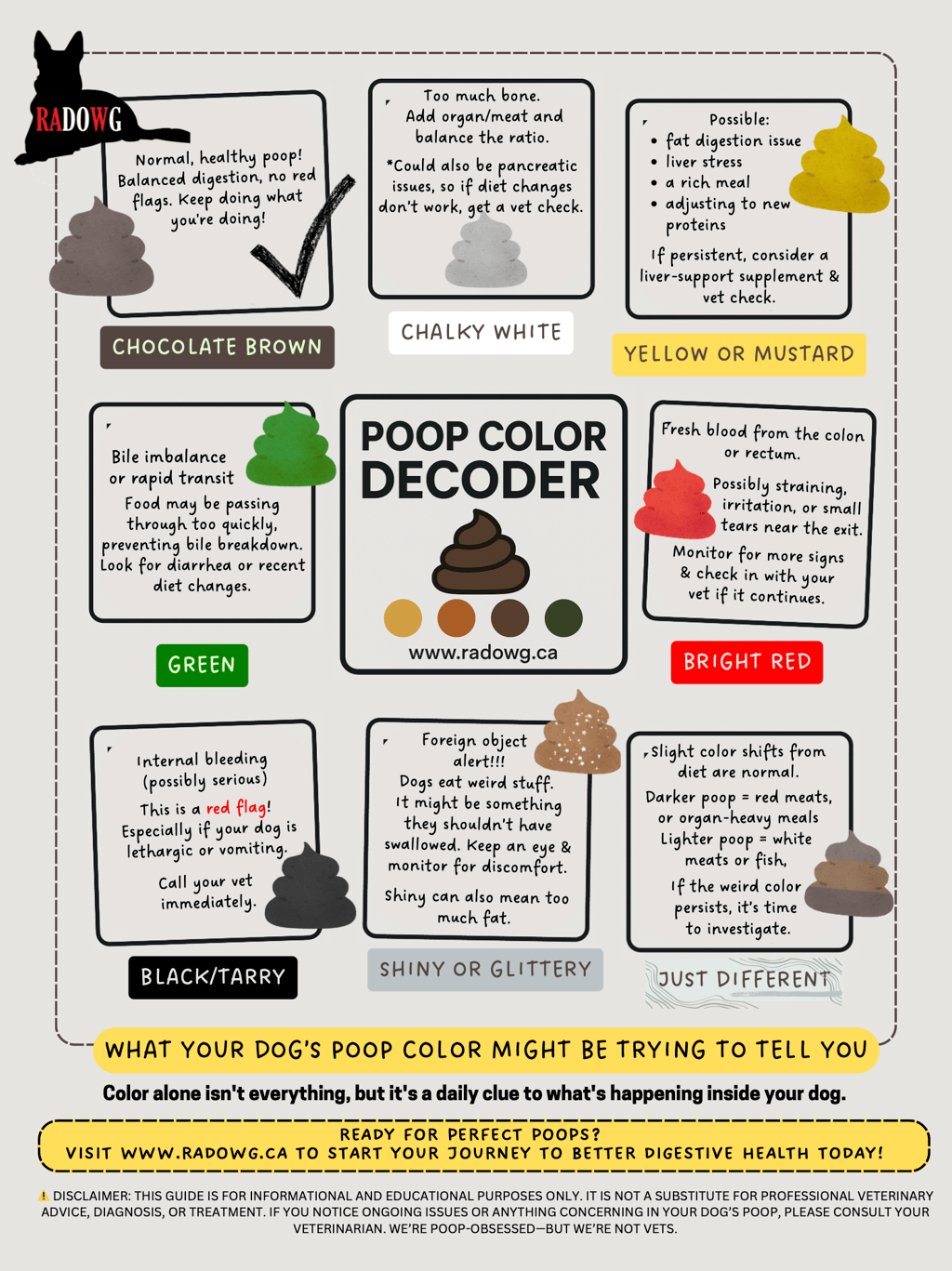
👉 Download the FREE printable Poop Colour Decoder and become a backyard poop detective.
It's a quick visual guide you can print or save for reference!
(You’ll never look at 💩 the same way again.)
Questions about how to get your dog’s digestion on track? Contact Radowg anytime—we’re happy to help.
📚 References & Further Reading
- Freeman, L. M., et al. (2013). Current knowledge about the risks and benefits of raw meat–based diets for dogs and cats. Journal of the American Veterinary Medical Association, 243(11), 1549–1558.
- Schlesinger, D. P., & Joffe, D. J. (2011). Raw food diets in companion animals: A critical review. The Canadian Veterinary Journal, 52(1), 50–54.
- Case, L. P. (2010). The Dog: Its Behavior, Nutrition, and Health (2nd ed.). Wiley-Blackwell.
- Waltham Centre for Pet Nutrition. (2021). Faecal Characteristics as an Indicator of Gastrointestinal Health.
- Meyer, H., & Zentek, J. (2005). Nutrition of the Dog and Cat. Nottingham University Press.
- National Research Council (NRC). (2006). Nutrient Requirements of Dogs and Cats. The National Academies Press.